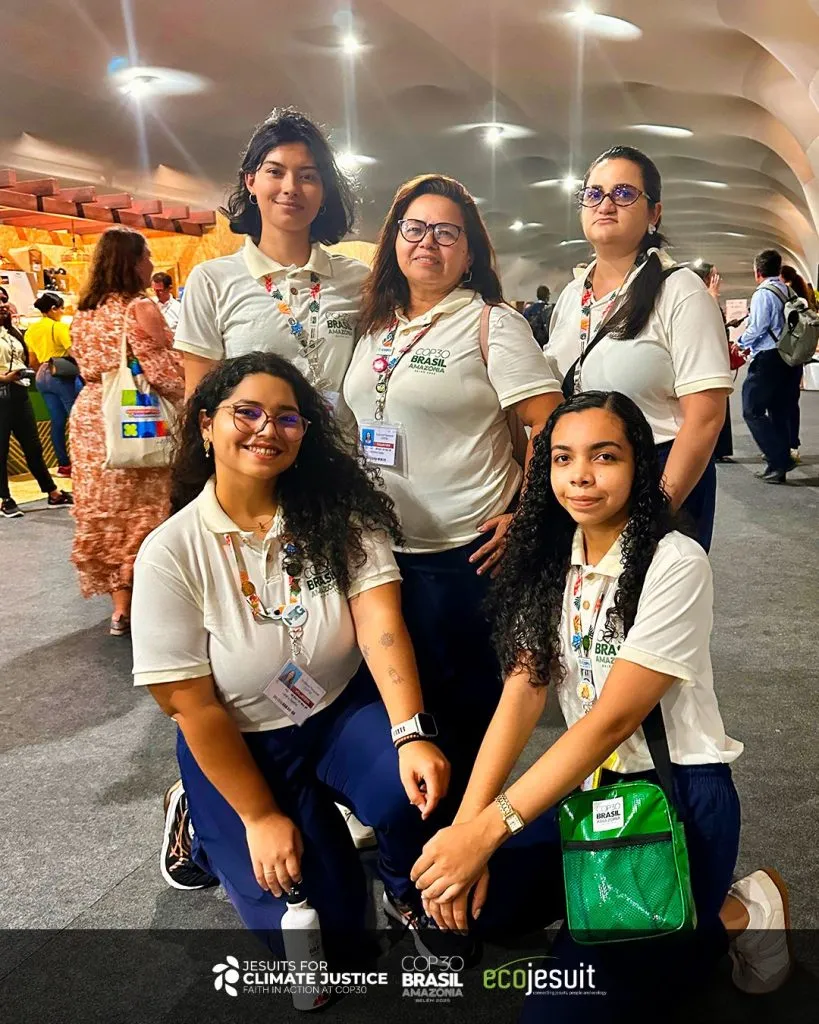
There’s something for everyone at COP30
By Agnaldo Junior SJ, Socio-Environmental Delegate of Conference of Jesuit Provincials in Latin America and the Caribbean (CPAL)
The spaces built for COP30 in Belém do Pará, Brazil — beyond the Blue and Green Zones (the official areas for States and meaningful civil society participation) — are making this COP30 a truly inclusive one.
The People’s Summit at the Federal University of Pará, one of the key spaces, brings together a wide diversity of civil society organizations to foster vital dialogues on the most urgent issues for confronting climate change as experienced in territories, communities, and people’s daily lives.
On the first day, I was in the Green Zone following discussions on the Amazon Fund and popular mobilization for the development of public policies. On the second day, I was at the Ecumenical Tapirí (a space for ecumenical and interfaith dialogue), where the topic was the current landscape of International Cooperation — a highly relevant theme for our third-sector organizations working on advocacy projects across different territories.
On the third day, I spent time in the Blue Zone, following discussions on water issues in the Pan-Amazon region and on “green jobs” as a way to promote employment models that are more environmentally sustainable.
On the fourth day (today), I am at the People’s Summit, accompanying the Children’s Summit and a session on the Rights of Nature, in which several organizations from the Jesuit Province of Brazil are participating.
Two aspects have particularly drawn my attention across all these spaces:
- The sheer number of topics addressed everywhere — yet when we look through the lens of Integral Ecology, we see how interconnected they all are. There is no issue that stands apart from the urgent call to care for our Common Home.
- The strong presence and active participation of civil society strengthens my hope in achieving our shared goals. In the socio-environmental field, no progress has ever been made without collective action, coordination, and popular movements. The agreements and commitments countries will adopt at this COP will not be implemented unless civil society, organizations, and faith-based institutions fulfill their essential role of monitoring, supporting, and carrying advocacy processes forward. Building bridges among all these actors — and recognizing them as key contributors — is urgent.
As faith-based organizations, the Lord invites us to believe in the seeds of hope held in the hands of the small and in popular movements — like the mustard seed — for this is how the Word became flesh.